
Yard drainage — Lake Norman, NC
Yard drainage and French drain installation
Grading, French drains, catch basins and downspout routing that move water off Piedmont clay to somewhere sensible.
(01) Why the yard holds water
Piedmont clay does not drain on its own.
Most of the Lake Norman area sits on Piedmont red clay. It is dense, holds water for days after a storm, then shrinks and cracks as it dries. That cycle is why the same low spot stays soft all spring, why mulch washes out along the same line every year, and why a patio laid on it heaves.
Building lots make it worse. Grading strips the topsoil, compacts what is left and often leaves the yard falling toward the house. Downspouts dump a roof’s worth of rain beside the foundation, and lakefront lots add a slope that carries the neighbours’ runoff across yours on its way to the water.
Yard drainage is a diagnosis first, then the right mix of grading, pipe and outlet for the way water actually moves on your lot.
(02) How we diagnose it
Find where the water comes from before deciding where it goes.
If we can, we walk the yard in the rain. Standing water shows where it ends up; watching it move shows where it came from, and those are rarely the same place.
- Downspouts. Where each discharges and whether the extension actually carries water clear of the foundation.
- Low spots. Which are natural collection points and which were created by grading, a patio, a wall or a fence.
- Neighbour runoff. Whether water arrives from uphill lots or the street, and how much of the problem is not yours.
- Slab and crawlspace symptoms. Damp crawlspace walls, efflorescence on block, a weeping garage slab.
Only then do we design the fix, which is why we will not price drainage from a photo.
(03) The fixes
Every yard drainage fix we use, and when each is right.
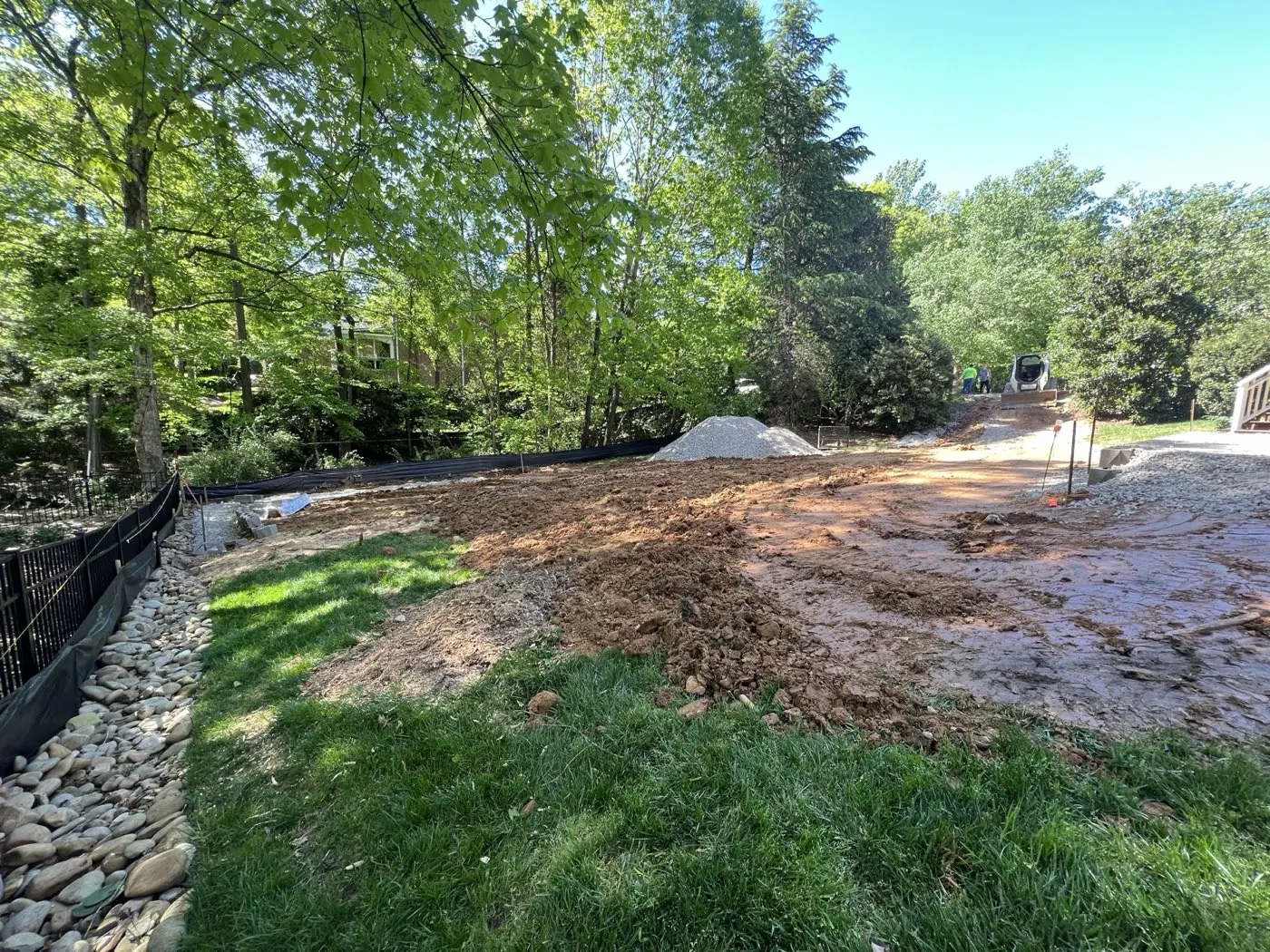
Regrading. The cheapest fix when it is the right one. If water sits because the ground falls toward the house or into a dish in the lawn, reshaping the soil to fall away at a steady pitch may solve it with no pipe at all.
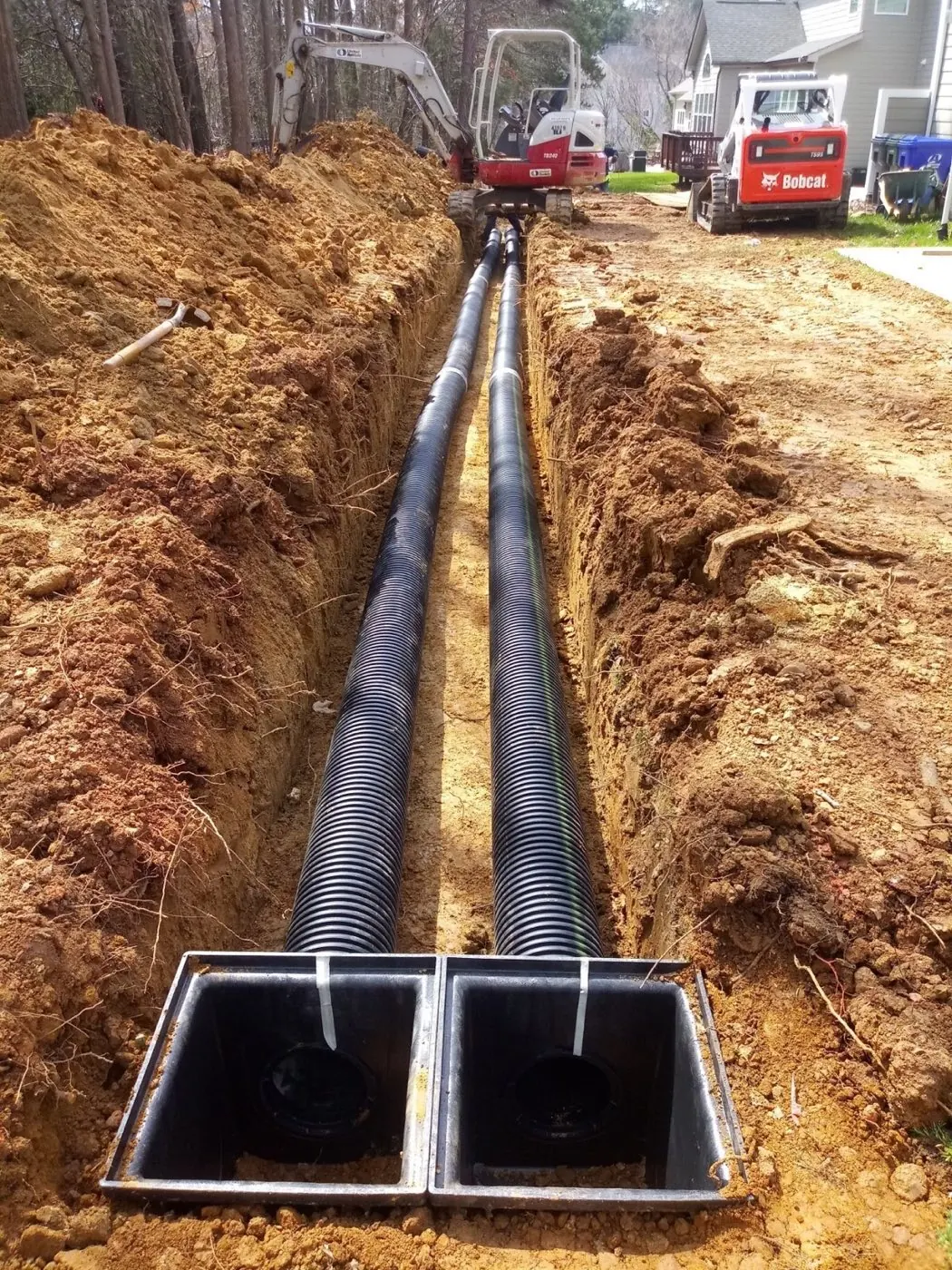
French drain. A trench holding a perforated pipe bedded in washed stone, wrapped in non-woven fabric that keeps clay fines out, falling steadily to an outlet. Water enters along the whole run, which makes it the right tool for saturated soil, a slope pushing water at a foundation, or the back of any wall holding wet ground.
Channel drain. A slotted trench drain set flush into a hard surface. Where sheet water runs across a driveway, pool deck or patio toward a door, it catches the flow and pipes it away. It does nothing for water in soil.
Catch basins and solid pipe. A grated box at a low spot, connected by solid (not perforated) pipe to an outlet. This empties a specific puddle quickly, and several basins and downspouts can share one pipe run.
Downspout extensions. Buried solid pipe carrying roof water to daylight or a dry well. Roof water is often the biggest volume in a yard, and getting it away from the house fixes many wet crawlspaces on its own.
Dry wells. A buried chamber or stone pit that takes water in and lets it soak away where there is no downhill outlet. In clay they work only when sized generously and fed a manageable volume.
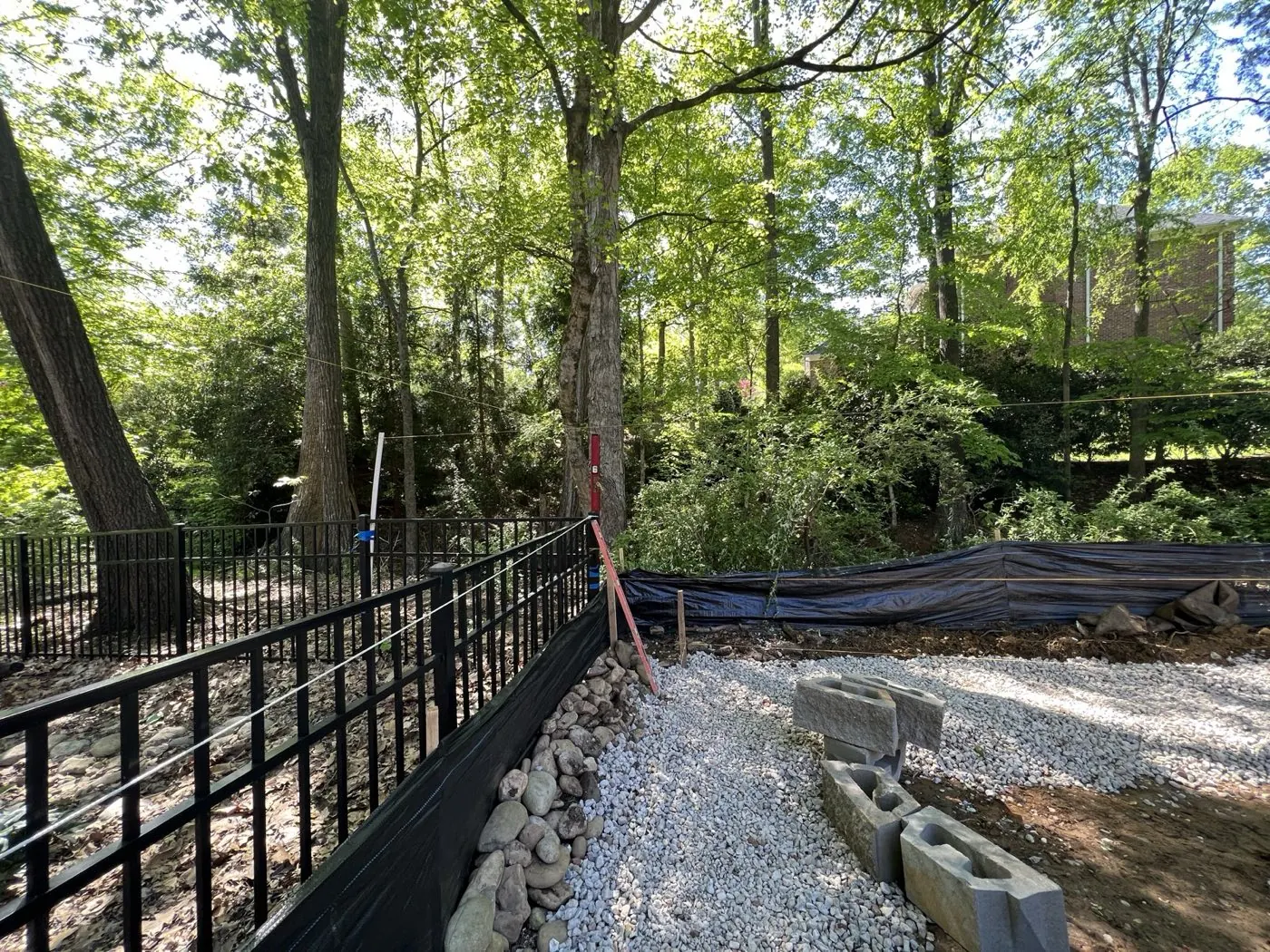
Swales. A shallow, gently falling channel shaped into the lawn or dressed in river rock, guiding surface water across the yard to an outlet. Low cost, and often the right answer for water arriving from an uphill neighbour.
Permeable pavers. Pavers on an open-graded stone base with wide, chip-filled joints, so rain soaks through into a reservoir below instead of running off. An option for a new driveway or patio where runoff is the whole problem.
(04) The outlet
Where the water actually goes.
Every drain is only as good as its outlet, and the outlet is where most yard drainage fails.
Daylight. The pipe runs downhill until it exits the ground at a lower point, finished with a grate or rock apron. Gravity does the work and there is nothing to maintain.
Pop-up emitter. Where the pipe can reach a lower lawn but not a bank, a spring-loaded emitter sits flush in the grass, lifts under flow and closes again.
Dry well. When there is no downhill anywhere, water goes into a dry well and soaks away. It is the last choice on clay.
We will not send water onto a neighbour’s property or into the street where an ordinance forbids it. If your lot has nowhere to send water, we say so at the estimate.
(05) Built into every project
Drainage is part of every patio and wall we build.
Water is why walls lean and patios settle, so every retaining wall we build carries clean stone and a perforated pipe behind the block, every paver patio is pitched to shed water and built on a base that lets it through, and a pool deck gets a channel drain wherever splash would run toward the house.
One crew does all of it. If the fix is a French drain and a regraded lawn, we do that; if it is a low wall with drainage behind it and a terrace above, the same crew designs and builds it.
Read more in our guide to fixing standing water in a Carolina yard.
(06) Cost
What French drain installation costs.
National cost guides published in 2026 put an exterior French drain at roughly $10 to $35 per linear foot installed. A shallow yard drain runs about $10 to $25 per foot, or $1,000 to $2,500 for a typical run; a deeper drain protecting a foundation runs $25 to $50 per foot, or $2,500 to $6,500; and a curtain drain intercepting a hillside runs $12 to $30 per foot. The same guides put the national average project near $5,000 and a typical 60 to 100 foot exterior run at $2,800 to $4,500.
They also list what adds to it, each by roughly $500 to $2,000: clay soil, rock, tree roots, buried utilities and crossing an existing patio or driveway. Around Lake Norman clay is a given and roots are common. We price after a site visit, in writing, with the outlet, pipe, stone and fabric named on the quote.
More detail in our guide to French drain cost in North Carolina.
Drainage work
Start your project →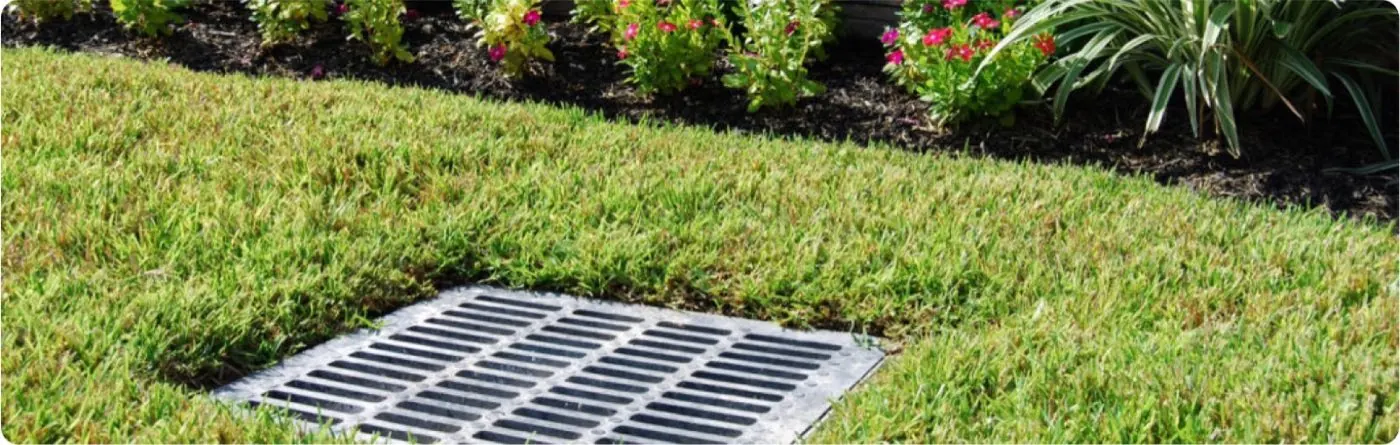
(07) Drainage questions
Asked often.
How much does a French drain cost in NC? +
How deep is a French drain? +
Will a French drain fix a wet crawlspace? +
How long does a French drain last? +
Do I need a permit for yard drainage in Mecklenburg County? +
Can you fix drainage without tearing up my patio? +
(08) Where we do this work
- French drain cost in NC — Per-foot ranges and what changes the number on a clay lot.
- Fixing standing water in a Carolina yard — Find the cause, then pick the drainage fix that solves it.
- Why retaining walls lean and fail — Water, base and reinforcement, and how to spot trouble early.
- Lakefront hardscaping on Lake Norman — Slope, access, drainage and shoreline rules.
Free on-site estimate
Let’s walk your wet yard.
Tell us where the water sits. We come out, find where it comes from, and put a written drainage plan and price in your hands.