
Paver walkways & steps — Lake Norman, NC
Paver walkway installation for Lake Norman homes
Front entry walks, garden paths, steps and landings in concrete pavers, clay brick and flagstone, built on a compacted base that stays level in Carolina clay.
(01) Walkways & paths
What a walkway has to do.
A walkway is the first piece of hardscape anyone touches at your house, and it gets judged twice: from the street by the eye, and every day by the feet. It has to be wide enough, level enough, dry enough and lit enough, and it has to look as though it belongs to the house rather than the lawn.
Front entry walks carry guests from the drive or the street to the door. They set the tone for the house, so material, width and border matter more here than anywhere else on the property.
Garden paths connect the patio to the shed, the fire pit to the lawn, the gate to the back door. They can be narrower and more relaxed, in flagstone or cobble as well as pavers.
Side-yard paths run the tight strip between the house and the fence where the grass never grows and the water always sits. These are as much a drainage job as a paving job.
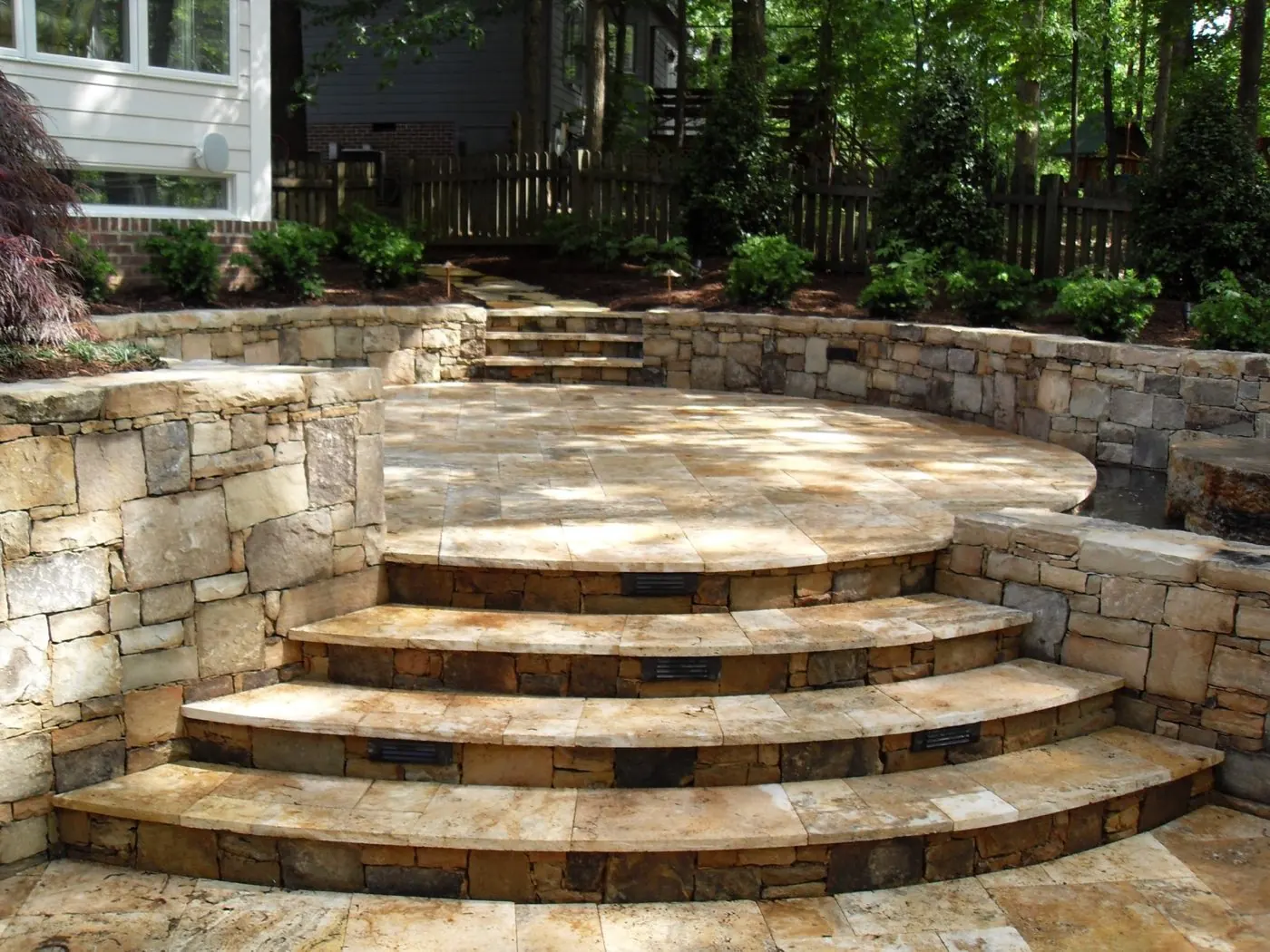
Steps and landings handle the grade most Lake Norman lots have somewhere. Where a walk climbs more than a few inches we build steps in block, brick or stone with a landing at the top. Our stone and brick masonry page covers step and cheek-wall work in more detail.
(02) Materials
Walkway pavers: concrete, brick, flagstone and cobble.
Concrete pavers. We install Techo-Bloc, Belgard and Unilock. They come in the widest range of sizes, textures and colours, cost less than brick or stone, and are the easiest to match to a modern or transitional house. Large-format slabs suit a clean contemporary walk; smaller blends suit a cottage or craftsman.
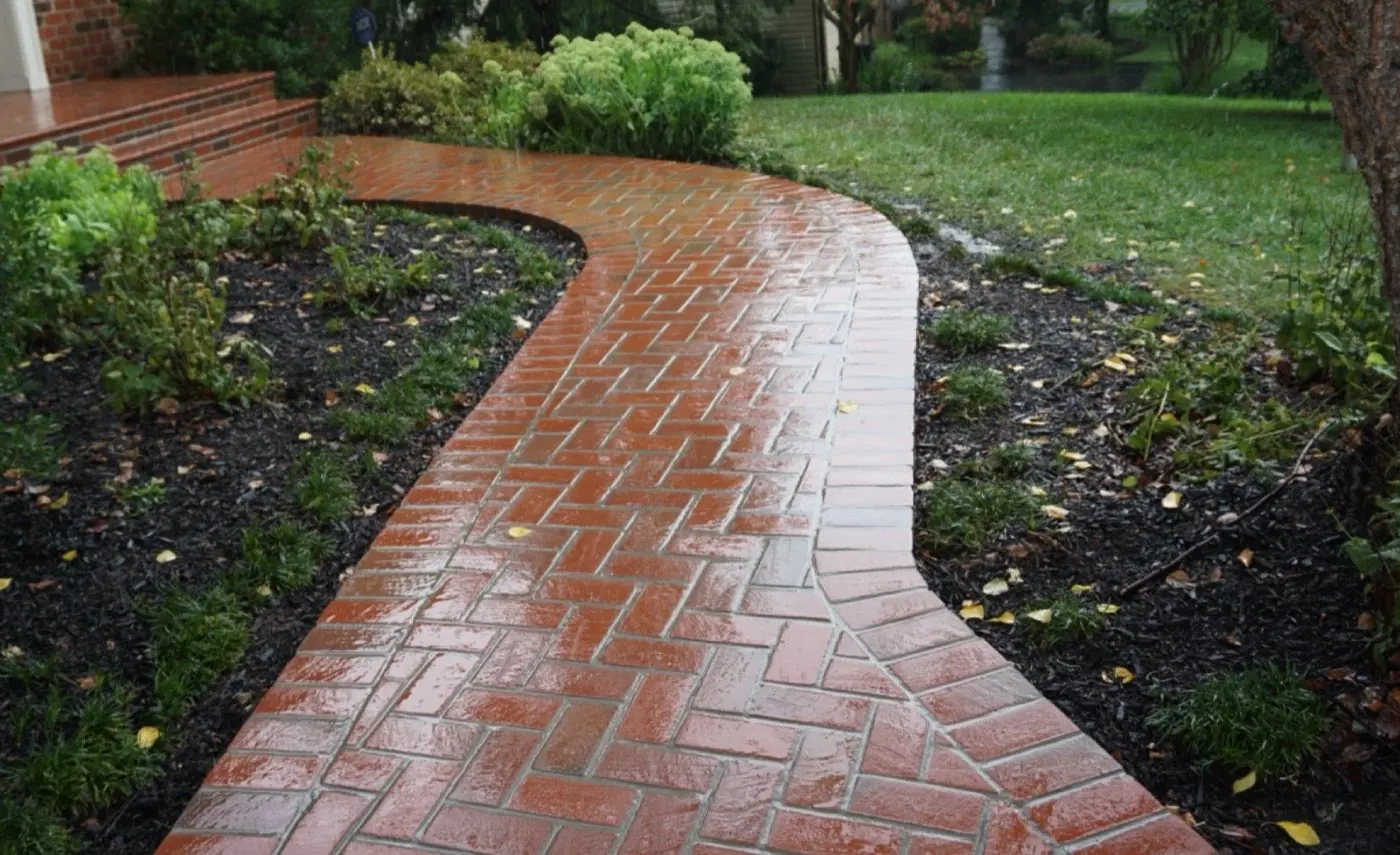
Clay brick. The colour is fired through the whole unit, so it never fades. Brick suits colonial, Georgian and farmhouse styles and pairs naturally with a brick home. Herringbone is the standard pattern for a walk because it locks the units against foot traffic; basketweave and running bond suit wider, more formal entries. See our brick paver page for how we handle brick.
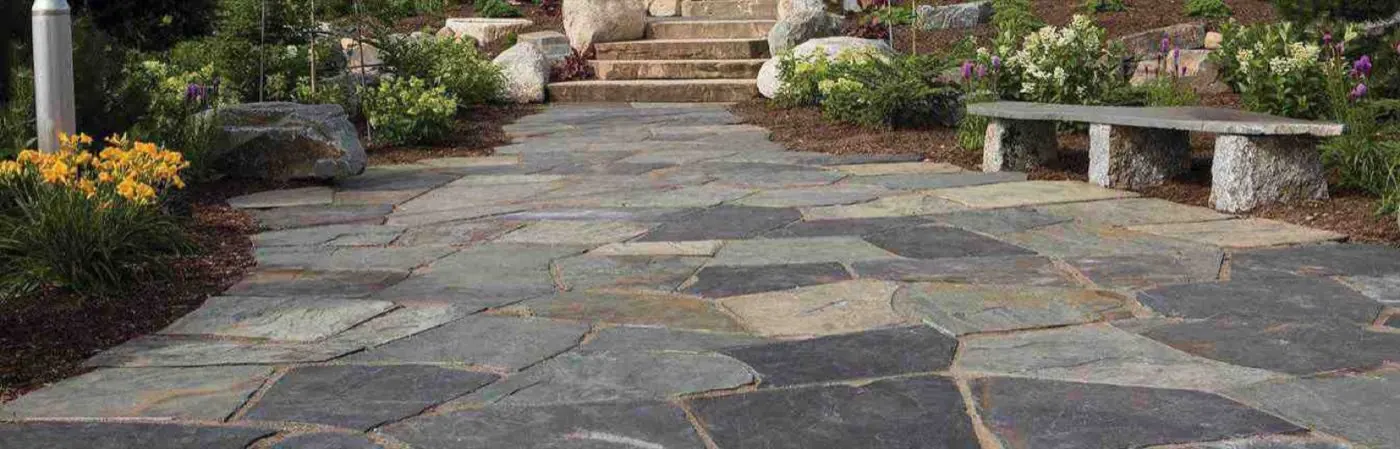
Flagstone. Irregular bluestone gives a natural, informal path, dry-laid in stone dust with planted joints or mortared on a slab for a tighter surface. It is the right answer for a woodland garden path and the wrong answer for a formal entry on a symmetrical house. Our flagstone page covers the trade-offs.
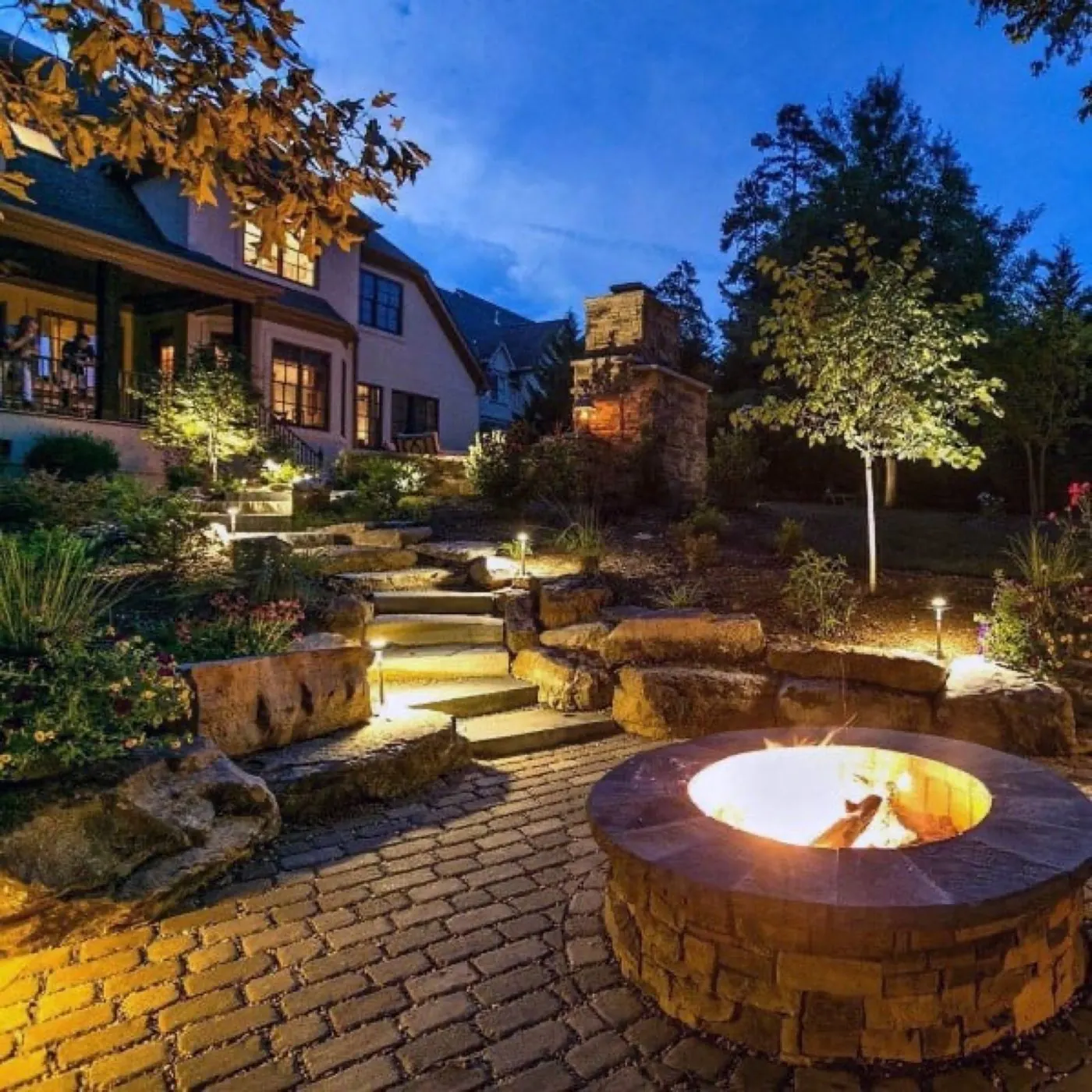
Cobble. Granite or tumbled concrete cobbles make a textured, old-world walk or a border for a plainer field. They are harder underfoot and cost more to lay, so we use them where the look earns it.
(03) The base
Built on a base, not on sand.
A walkway carries feet, not cars, so the compacted aggregate base under it does not need to be as deep as a paver driveway needs. But on Piedmont red clay it does need to be there and built properly, because clay holds water and moves when it freezes. A walk laid on an inch of sand over clay looks fine for a summer and ripples within a few winters.
We follow CMHA (Concrete Masonry & Hardscapes Association) guidance for the build-up. Excavate to the design depth. Where the clay is soft, place a geotextile separation fabric so the stone cannot punch down into it. Place open-graded aggregate in lifts and compact each one. Screed a thin bedding layer, lay the pavers, compact them into the bedding, and restrain every edge with a spiked restraint or a concrete haunch so the field cannot spread. Sweep in joint sand and compact again.
Our paver patio installation guide walks through the same sequence step by step at patio scale.
(04) Design details
Width, borders, lighting and water.
Width. For a front entry walk we usually recommend 4 to 5 ft so two people can walk side by side and the path sits in proportion to the house. Garden and side-yard paths are usually fine at about 3 ft. These are general practice, not rules; a broad house wants a broader walk.
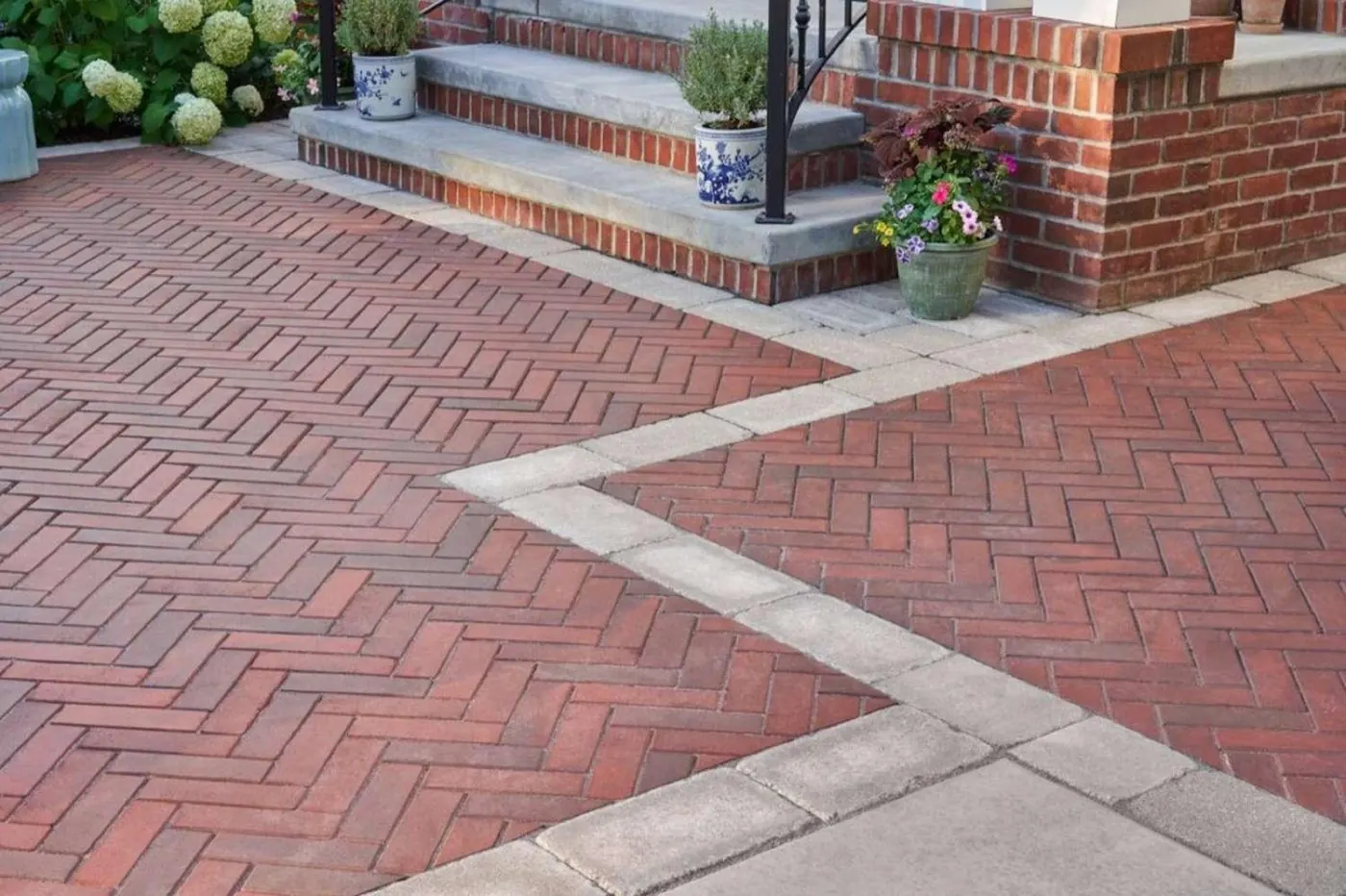
Borders and soldier courses. A border course laid perpendicular to the field, called a soldier course, frames the walk, hides the cut edges of the pattern and stiffens the perimeter. A contrasting colour, a charcoal border on a grey field or brick on pavers, is the cheapest way to make a plain walk look designed.
Lighting conduit. If you may ever want path lights, we lay conduit under the walk before the base goes in. It costs little on the day and saves lifting finished pavers later.
Drainage and grading. Every walk is pitched to shed water away from the house, and where a side-yard path sits in a low strip we set a channel drain or catch basin into it and tie that into the property’s drainage. Standing water on a walk is ice in January and algae in July. If the yard already holds water, our yard drainage page explains how we fix the cause rather than paving over it.
Matching an existing patio. A new walk should read as part of the same design as the paver patio it leads to. Where the patio paver is still in production we source the same unit and colour; where it is not, we pick a complementary paver and use a deliberate border at the junction so the change looks intended.
(05) Cost
What a paver walkway costs.
National cost guides published in 2026 put installed paver walkways at roughly $18 to $35 per square foot for small jobs, which works out to about $2,000 to $3,500 for a typical 100 sq ft front walk. Concrete pavers on a straight run with good access sit toward the bottom of that range; clay brick, flagstone, curves, steps and contrasting borders push toward the top. The South tends to run a little under national figures.
Those are national numbers, not ours. We price after a site visit, because what moves the estimate is what we cannot see from the road: how far material travels from the truck, how much grade the walk climbs, whether the clay needs geotextile and extra base, and what happens to the water.
Once a walk is in, a periodic clean, re-sand and seal, covered on our paver cleaning and sealing page, keeps joint sand in place and stops weeds and staining before they start.
Recent walkways and steps
Full gallery →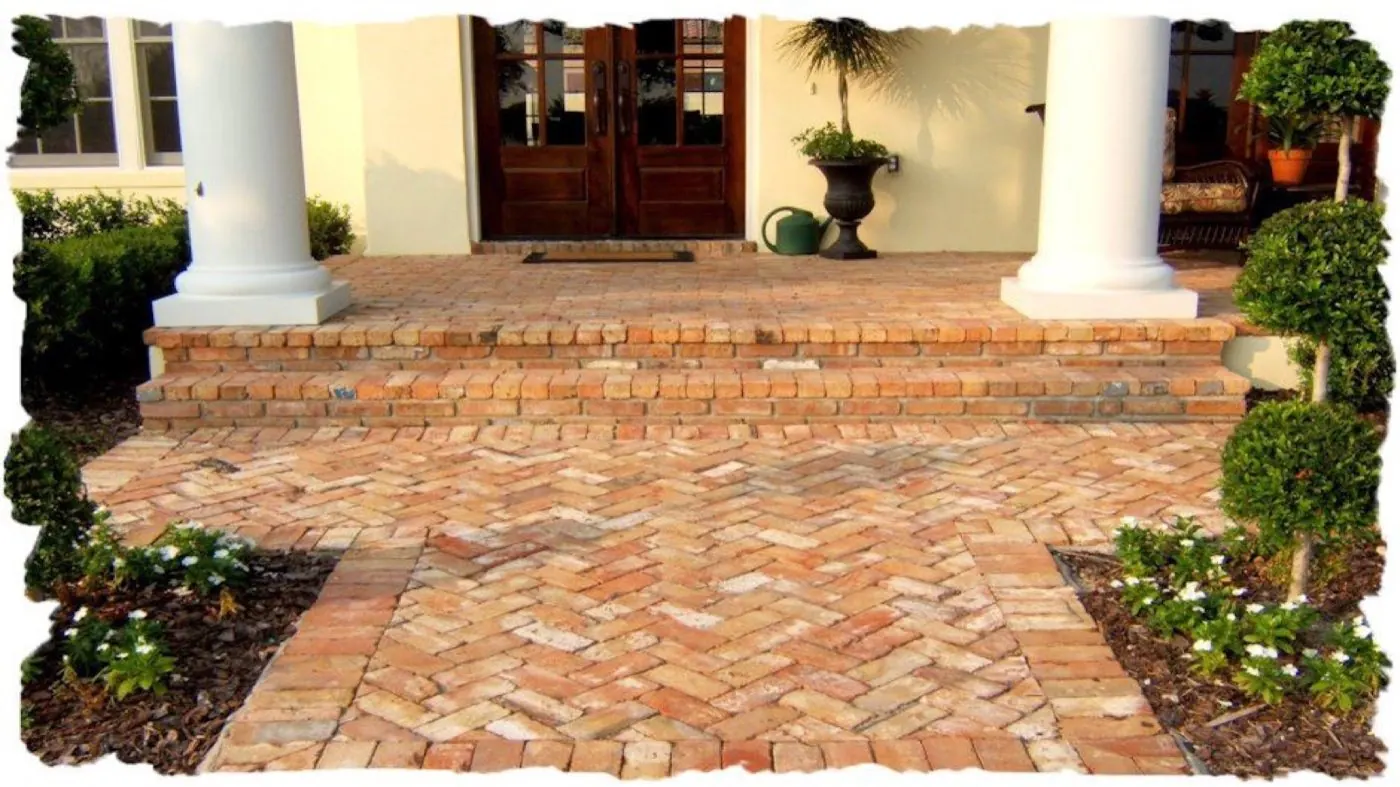
(06) Where we build walkways
Huntersville/Cornelius/Davidson/Mooresville/Troutman/Denver/North Charlotte
(07) Walkway questions
Asked often.
How wide should a front walkway be? +
How much does a paver walkway cost? +
Do paver walkways need a base like a patio? +
Can you match a new walkway to my existing patio? +
Brick or concrete pavers for a walkway, which lasts longer? +
Free on-site estimate
Let’s walk the path to your door.
Tell us where the walk needs to go. We come out, measure the run and the grade, and put a clear written estimate in your hands.