
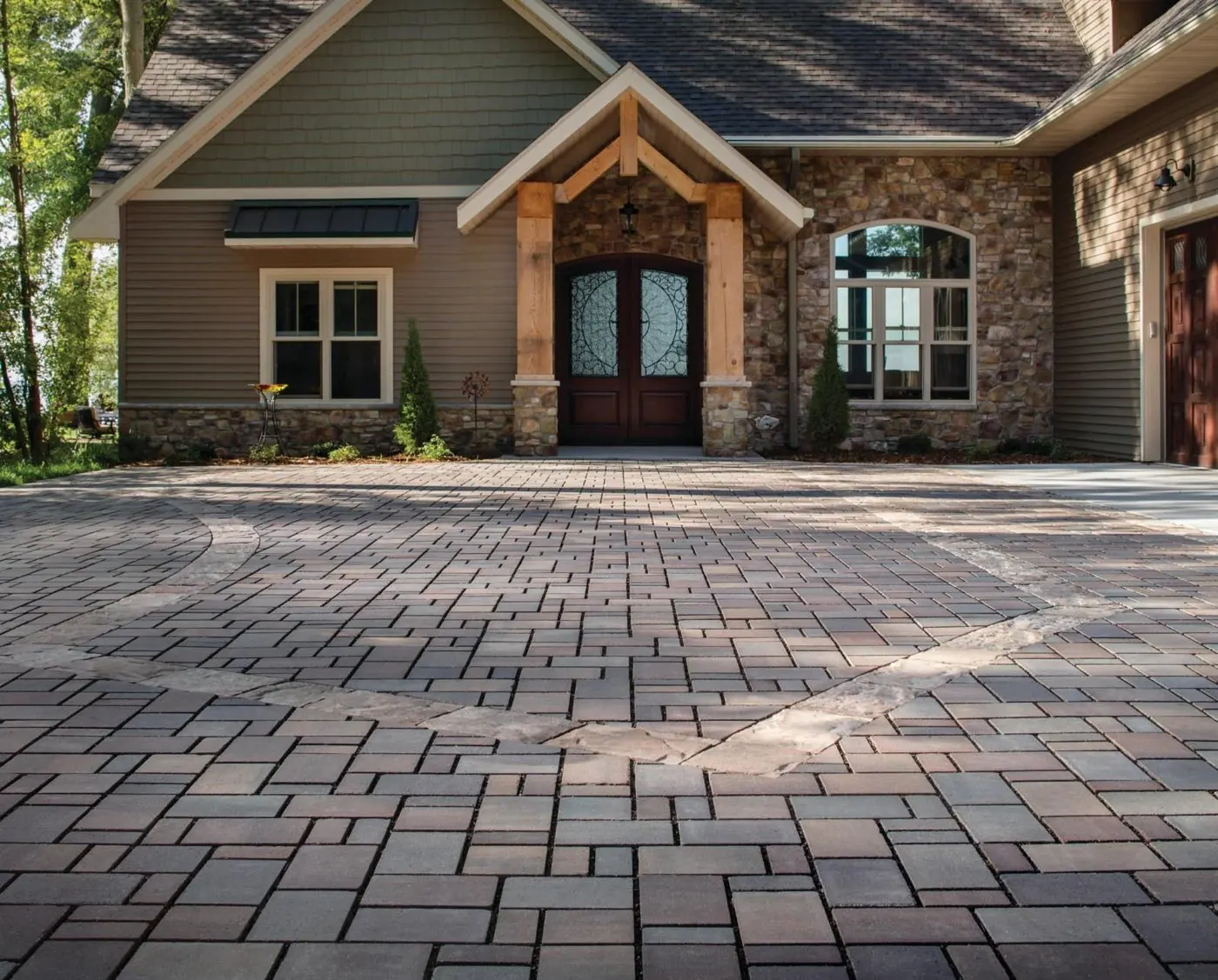
Paver driveways — Lake Norman, NC
Paver driveway installation in Lake Norman
Vehicular-rated pavers on a deep compacted base, with aprons, borders and inlays that make the drive part of the house.
(01) Pavers vs poured concrete
Why pavers for a driveway.
A driveway is the biggest hard surface on most lots and the one that takes the most punishment: cars turning on it, oil dripping on it, and the clay underneath swelling every wet winter. Poured concrete handles that by cracking. The control joints sawn into a slab decide where the cracks go, not whether they happen, and on Piedmont clay they happen.
Pavers are repairable. A paver driveway is thousands of units on a flexible base. If a section ever settles, stains or has to come up for a utility repair, we lift those pavers, fix the base and re-lay the same units. No patch, no colour mismatch, no saw cut.
No crack lines. The joints between pavers are part of the design, so the surface never develops the random cracking or the sawn grid of a jointed slab. Pavers move slightly with the ground and settle back, which a rigid slab cannot do.
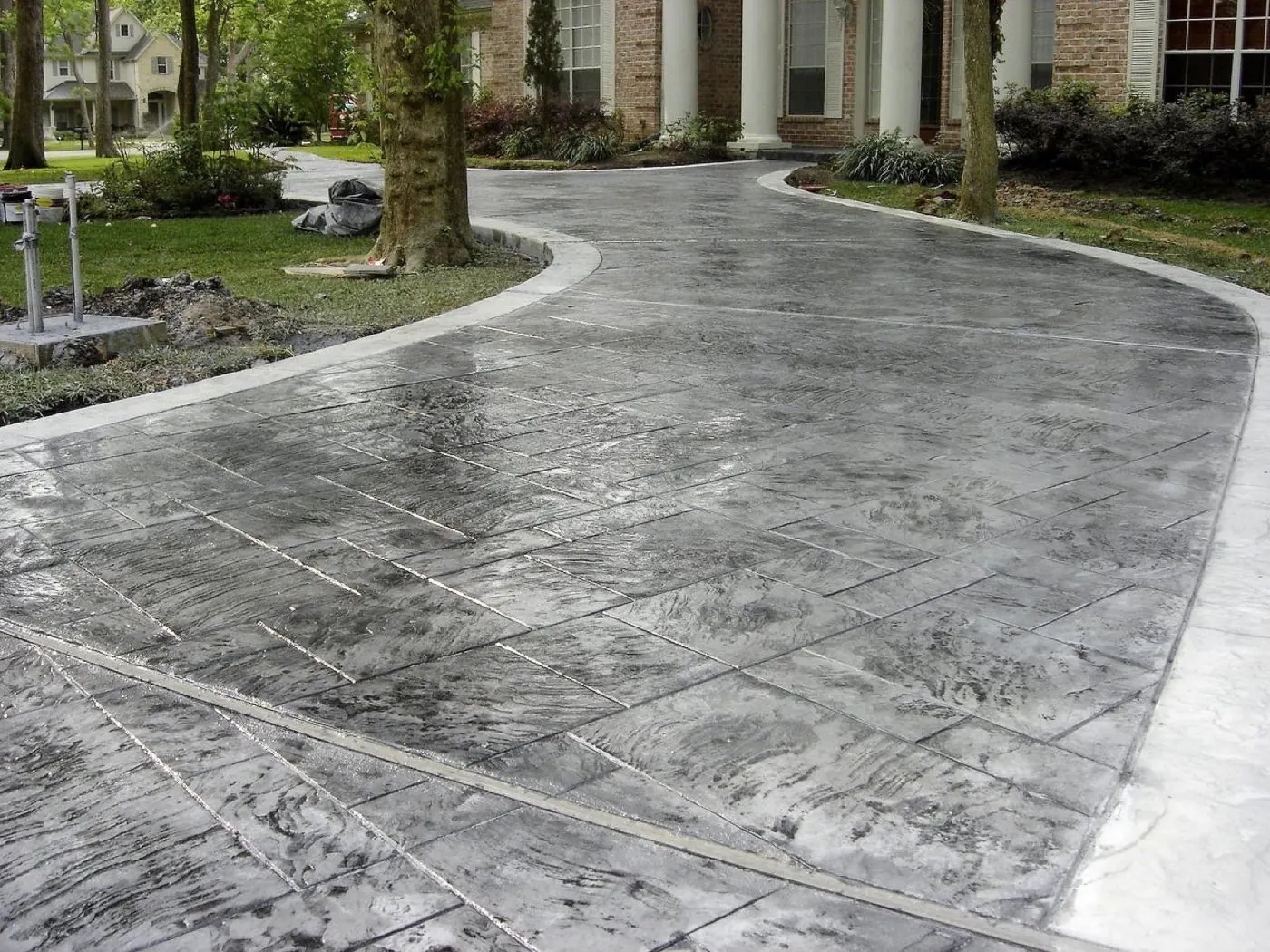
Concrete is still the cheaper surface up front, and a well-finished stamped drive can look very good. If price leads, our custom concrete page covers stamped driveways, and our guide to pavers vs concrete on Carolina clay lays out the trade-offs.
(02) Built for the load
A driveway base is not a patio base.
The paver you see is the least important structural part of a driveway. What holds the car up is the compacted aggregate base beneath it, and a drive needs considerably more of it than a paver patio does. CMHA (Concrete Masonry & Hardscapes Association) guidance for vehicular applications governs how deep we go, and on soft Lake Norman clay that is deeper than on sandy ground.
The build-up. Excavate the full depth, including the old drive if there is one, and dig out any soft spots in the clay. Place a geotextile separation fabric so the stone cannot punch into the clay and the clay cannot pump up into the stone. Place open-graded aggregate in lifts and compact each one, holding a grade that runs water away from the garage. Screed a thin bedding layer, lay the pavers, compact them in, sweep in joint sand and compact again.
Vehicular-rated pavers. Manufacturers rate each product for pedestrian or vehicular use, and driveway units are thicker than the ones sold for patios and walkways. We install Techo-Bloc, Belgard and Unilock pavers rated for driveways only; a patio paver on a drive will spall at the edges and rock in its bed within a few years, however good the base is.
Edge restraint. Cars push a paver field outward every time they turn on it, so every drive we build has a concrete haunch or a heavy spiked restraint along every unsupported edge, set on the base rather than the bedding sand so it cannot lift. The same sequence at patio scale is in our paver patio installation guide.
(03) Design
Aprons, borders and inlays.
Aprons. The apron is the flare where the drive meets the street or the garage. A contrasting apron in a darker paver, or a change of pattern, marks the transition and hides the tyre scrub that collects there.
Borders. A soldier course or a double border in a contrasting colour frames the drive, stiffens the perimeter and hides the cut edges of the field.
Circular inlays. A circle kit or cobble medallion set into the turning area in front of the garage gives the drive a centre.
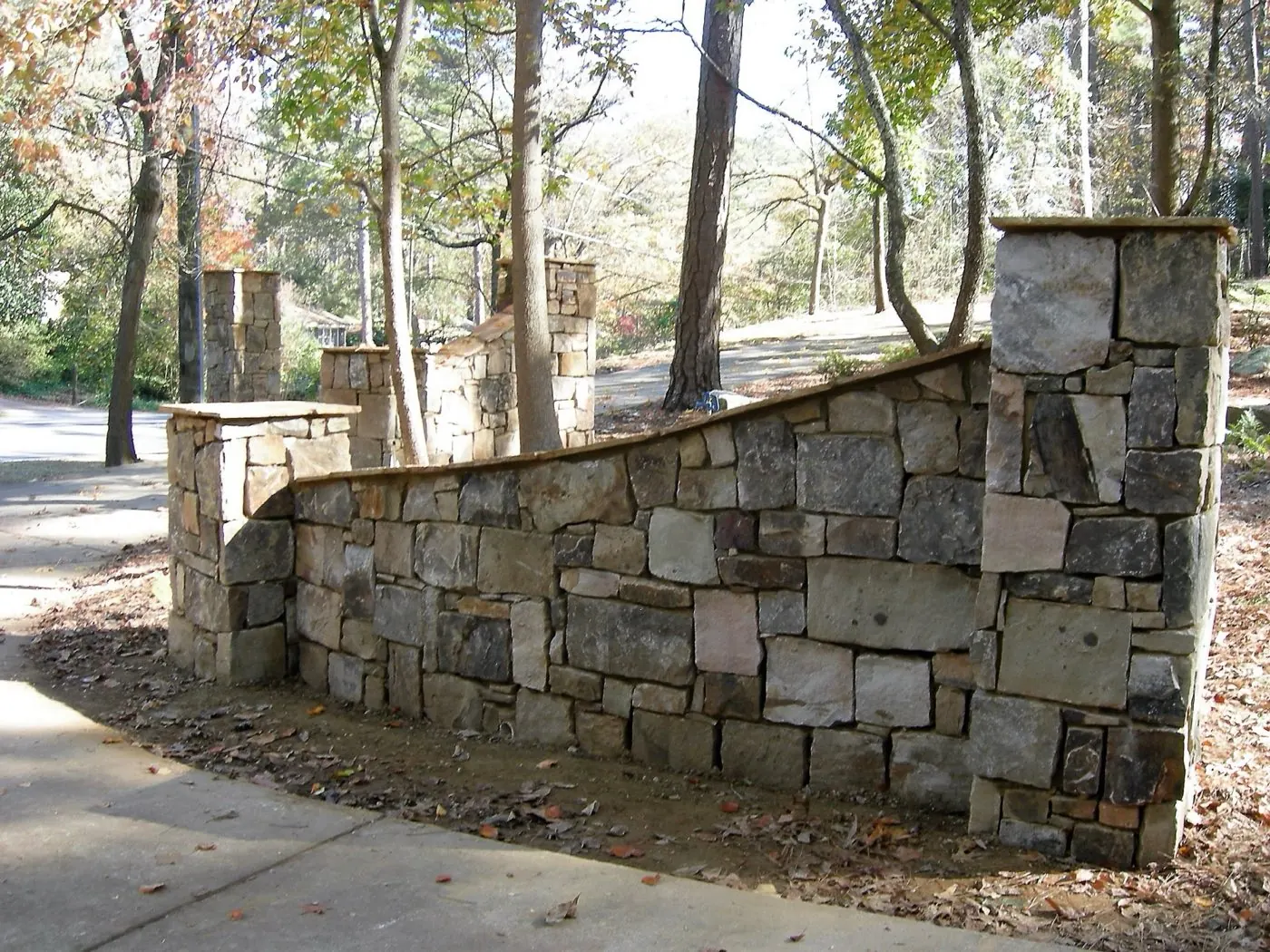
Matching the walk. The drive and the front paver walkway should read as one design, so we carry the border colour or the field paver from one to the other. Conduit for pillar or path lights goes in before the base, not after.
(04) Stormwater
Permeable paver driveways and Carolina clay.
Permeable pavers have wider joints filled with small clean stone instead of sand, and they sit on an open-graded stone reservoir rather than a dense base. Rain passes through the joints into the reservoir and soaks slowly into the ground instead of running to the street.
The complication here is the clay. Piedmont red clay drains poorly, so a permeable drive over tight clay can fill its reservoir in a long storm and behave like a bathtub. We design for that by sizing the reservoir to the drive and adding an underdrain or overflow that ties into the property’s yard drainage. The units cost more and the excavation is deeper, so the case for them is strongest where a lot already has drainage trouble or an impervious-surface limit.
(05) Before we dig
Aprons at the street, HOAs and utilities.
The last few feet of a drive, where it meets the road, usually sit in the public right-of-way. Replacing that apron commonly needs a driveway permit from the town, or from NCDOT on a state route, and some towns require the apron itself to be concrete. Many Lake Norman neighbourhoods also have an HOA architectural review that has to approve the paver colour and pattern first; we supply the drawings and samples and build that time into the schedule. Utilities are located before any excavation, and where a line crosses the drive we plan the base so a future repair can lift a strip of pavers without touching the rest.
(06) Upkeep
Sealing and looking after a paver drive.
A paver driveway does not have to be sealed, but sealing is the difference between a drive that shrugs off oil and tyre marks and one that slowly greys. A breathable sealer locks the joint sand in place so weeds stay out and the interlock stays tight. We let a new drive weather through a few weeks of rain before the first coat so efflorescence can work out.
Sealer choice and timing are covered on our paver cleaning and sealing page and in when to seal pavers.
(07) Cost
What a paver driveway costs.
National cost guides published in 2026 put installed paver driveways at roughly $18 to $40 per square foot. Within that, basic concrete pavers run about $18 to $28, interlocking pavers $20 to $34, clay brick $22 to $38, permeable pavers $24 to $45 or more, and cobble or granite $30 to $60 or more. Driveways cost more per square foot than patios because of the deeper compacted base the vehicle load requires.
Those are national figures, not our prices. We price after a site visit, because what moves a driveway estimate is the depth of base your clay needs, whether an old concrete drive has to be broken out, access for machines, the apron requirement and what the water is doing.
Driveways, entries and the alternative
Full gallery →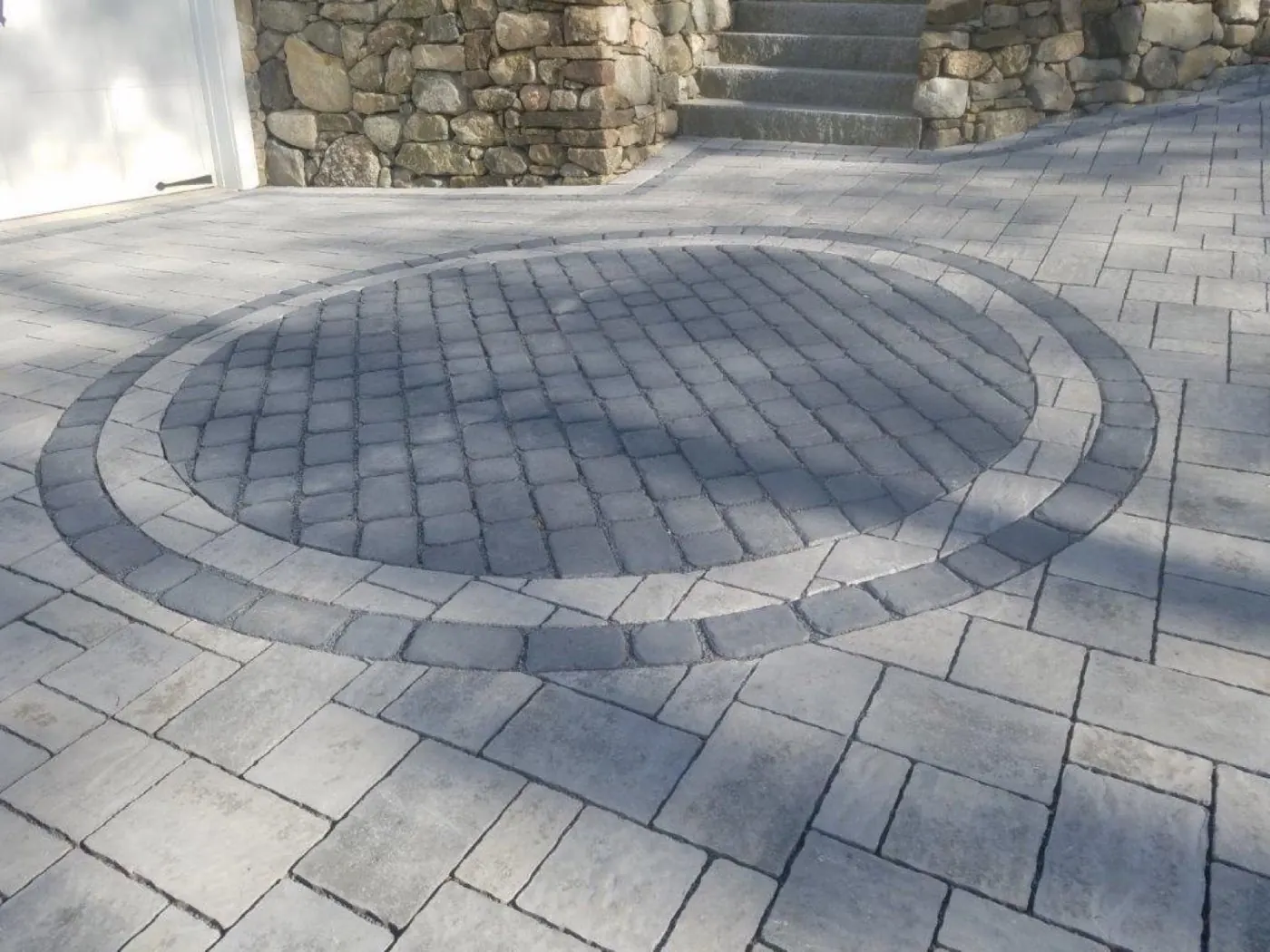
(08) Where we build driveways
Huntersville/Cornelius/Davidson/Mooresville/Troutman/Denver/North Charlotte
(09) Driveway questions
Asked often.
How much does a paver driveway cost? +
Are paver driveways better than concrete? +
How thick should driveway pavers be? +
Do paver driveways sink or shift? +
Can you install a permeable paver driveway? +
Free on-site estimate
Let’s walk your driveway.
Tell us what you are replacing or building. We come out, measure the drive and the grade, and put a clear written estimate in your hands.