
Costs & planning · 7 min read
French drain cost in North Carolina: what drives the price
The national per-foot ranges, what red clay and tree roots do to them, and how to tell a real drainage quote from a cheap one.
Introduction
A French drain is one of the few hardscape jobs where the price is mostly underground. The pipe and stone are a small part; the digging, disposal, fabric and where the water finally goes are what you pay for. Two drains of the same length on two Lake Norman lots can land thousands apart, and both quotes can be honest.
This guide lays out the national 2026 figures, then explains what moves them on Piedmont clay. Our yard drainage and French drain installation page explains how we diagnose a wet lot before proposing anything.
(01)
What a French drain actually is, and is not
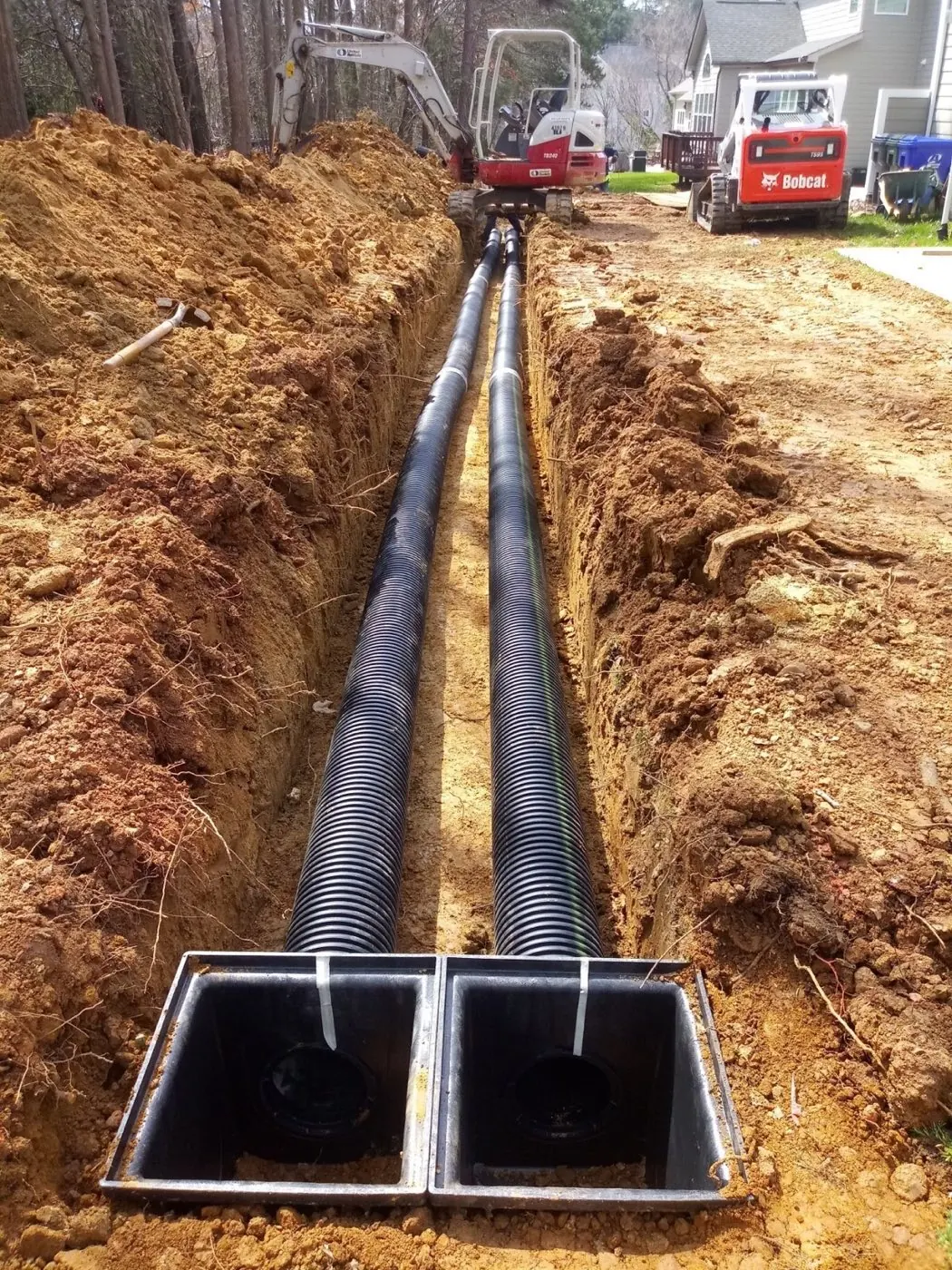
A French drain is a trench, sloped toward an outlet, holding a perforated pipe bedded in washed stone and wrapped in non-woven filter fabric. Water in the soil moves into the stone, drops into the pipe and runs downhill to daylight, a pop-up emitter or a dry well. It collects along its whole length, which makes it the right tool for saturated ground and the wet side of a foundation or retaining wall.
It is not a catch basin with a pipe; that is a point drain, which empties a puddle, not a soaked lawn. It is not a channel drain, which catches water sheeting across a hard surface. And it is not a buried downspout extension, which is solid pipe carrying roof water. People use French drain loosely for all four, which is one reason quotes are hard to compare.
(02)
French drain cost per linear foot: shallow yard drain, deep foundation drain, curtain drain
National cost guides published in 2026 put an installed exterior French drain at roughly $10 to $35 per linear foot. Inside that band the type of drain sets the starting point.
- Shallow yard drain. Around $10 to $25 per foot, or $1,000 to $2,500 for a typical run: a trench a foot and a half to two feet deep, catching surface and near-surface water in a lawn or bed.
- Deep exterior or foundation drain. Around $25 to $50 per foot, or $2,500 to $6,500: dug toward footing depth beside a house or tall wall, with far more spoil out and stone in.
- Curtain drain. Around $12 to $30 per foot: cut across a hillside above the wet area to intercept water before it arrives, often the most cost-effective drain on a sloping lot.
The same guides put the national average project near $5,000 and a typical 60 to 100 foot exterior run at $2,800 to $4,500. Treat these as a sanity check for a quote, not a price list. We price after a site visit.
(03)
What changes the number on a Lake Norman lot
National averages are built on national soil. Ours is different, and the 2026 guides list clay, rock, tree roots, buried utilities and crossing existing hardscape as each adding roughly $500 to $2,000. Here is what each looks like on the ground here.
Red clay. Piedmont clay digs slowly, sticks to everything and drains so poorly that the pipe needs a wider stone envelope to give water a way in. More digging, more stone, more spoil to haul. Almost every Lake Norman drain carries this one.
Tree roots. Mature hardwoods and pines put roots exactly where the trench wants to go. Cutting through them is slow, and where a tree matters we route around it, which adds length.
Utilities locate. Gas, power, irrigation and lighting all cross a yard. The locate is free; hand-digging around marked lines instead of running a trencher through is not.
Crossing a driveway or patio. Concrete has to be saw-cut and patched. Pavers are easier: lift a strip, trench, relay the same pavers. Either way it is a separate line on the quote.
Where the outlet can go. A daylight outlet on a sloped lot is cheap. A flat lot needing a long run to reach fall, a pop-up emitter or a dry well sized for clay costs more, and a lot with no lawful place to send water may need a different approach.
Length of run. A 40 foot drain behind a patio and a 120 foot drain around two sides of a house are different jobs even at the same rate, and the longer run has to go deeper at the far end to keep its fall.
We price after a site visit; every one of these is visible on the lot and none in a photo.
(04)
French drain vs regrading vs channel drain: sometimes the cheaper fix is the right one
A French drain is not always the answer, and a contractor who reaches for one before walking the yard in the rain is guessing.
Regrading wins when water sits because the ground falls toward the house or into a dish in the lawn. Reshaping the soil to fall steadily away can cost less than a drain, especially with a machine already on site. It needs spare fall and somewhere for the water to go.
A channel drain wins when water sheets across a driveway, pool deck or patio toward a door. A slotted trench drain set into the surface and piped away solves that for less than trenching the lawn, and a French drain would not touch it.
A French drain wins when the soil itself stays saturated, when a slope pushes groundwater toward a foundation or crawlspace, or behind any wall holding back wet ground. Nothing else collects water along a whole line.
Many yards need a short run of two of these rather than a long run of one. The cheapest quote is often the one that diagnosed the problem correctly, not the one with the least pipe. We price after a site visit.
(05)
Why cheap French drains fail
A suspiciously low French drain quote usually leaves something out, and what gets left out is what makes it last.
- No filter fabric. Clay fines migrate straight into the stone and then the pipe. Within a few seasons the drain is a trench full of mud.
- Wrong stone. Crusher run or unwashed gravel packs tight and carries its own fines. Washed stone with open voids is the only kind that lets water move.
- No proper outlet. A pipe that ends in the ground, or in a dry well too small for clay, backs up the first time it is really needed.
- Pipe laid flat. Without steady fall from one end to the other, water sits in the pipe, silt settles, and the drain slows to nothing.
- Corrugated pipe crushed. Thin corrugated pipe under a lawn that gets mowed and driven on flattens and cannot be flushed. Smooth-wall pipe holds its shape and can be cleaned.
None of this is visible once the trench is closed, which is why the quote has to name it. The failed walls in our guide to why retaining walls fail nearly all trace back to missing drainage.
(06)
What to ask for in a written drainage quote
You do not need to be an expert to compare drainage quotes; you need them to answer the same questions.
- Which kind of drain it is: French, catch basin, channel or downspout line, and the length and depth of each run
- Pipe type and size, and whether it is smooth-wall or corrugated
- Stone type and whether it is washed, and the filter fabric named
- Where the outlet goes and how it is finished
- Whether the utilities locate, spoil removal and lawn or hardscape reinstatement are included
- A cleanout point so the drain can be flushed in future
- What happens if the trench hits rock, roots or an unmarked line
If a quote cannot answer those on paper it is not cheaper, it is incomplete. We put all of it in writing after a site visit; our guide to fixing standing water in a Carolina yard covers how we decide which fix to propose.
(07) Questions
Asked often.
How much does a French drain cost per foot? +
Is a French drain cheaper than regrading? +
Why is my French drain quote higher than the national average? +
How long does a French drain take to install? +
Does a French drain need a permit in North Carolina? +
Related services
Where this applies.
Free on-site estimate
Standing water somewhere it should not be?
Tell us where it sits. We come out, find where it is coming from, and put a written drainage plan and price in your hands.