
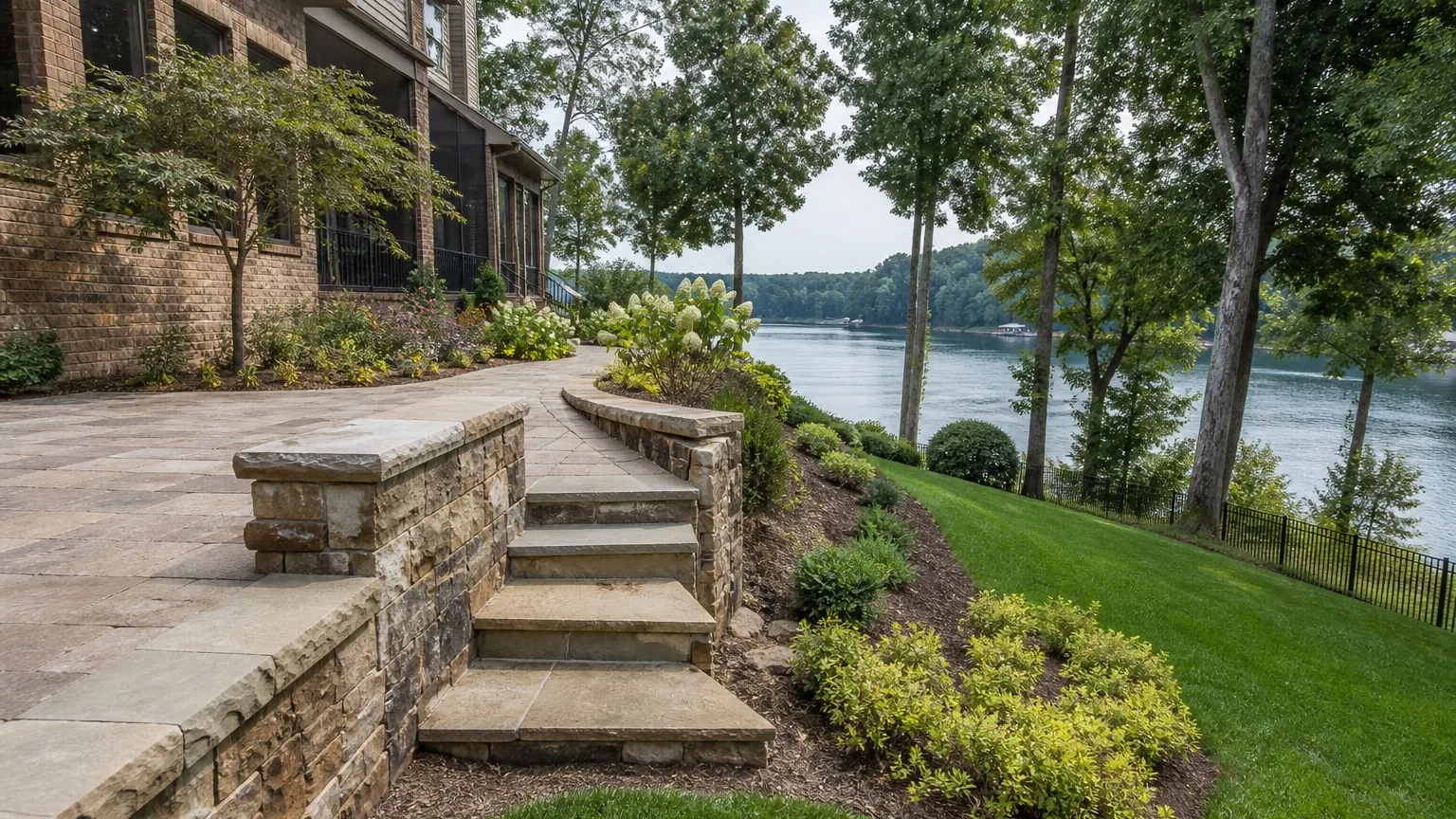
Introduction
Hardscaping is the built, non-living part of a yard: patios, walkways, retaining walls, steps, outdoor kitchens, fire features, and the grading and drainage that sit underneath them. Landscaping in the narrow sense, often called softscape, is the living part: lawn, shrubs, trees and planting beds. A patio is hardscape. The hydrangeas around it are not.
Carolina Custom Stone and Hardscape is a hardscape design and construction company based in Davidson, NC, established in 2018, locally owned, bonded and insured, building patios, retaining and seat walls, walkways, driveways, outdoor kitchens, fire features, masonry and drainage in Huntersville, Cornelius, Davidson, Mooresville, Troutman, Denver and north Charlotte. We do not plant, mow or maintain lawns. That line between the two trades is much of what this article is about, because it decides who you call, in what order, and what you are actually paying for.
The short version
Key Takeaways
- Hardscape is anything built: pavers, natural stone, block, brick and concrete, laid as floors, stacked as walls or shaped into steps, kitchens and fire pits.
- The base is the job. Around Lake Norman the surface sits on Piedmont red clay, and the compacted base, grading and drainage under it decide whether a patio or wall holds its line.
- Hard surfaces change where rain goes. The NCDA&CS permeable pavement manual notes that conventional concrete and asphalt convert nearly all rainfall to runoff, and its Community Conservation Assistance Program funds permeable pavement only in the Coastal Plain, Sandhills and barrier islands, not the Piedmont.
- Two trades, one yard. A hardscape crew grades, builds and leaves planting beds ready; a landscaper plants and maintains them. Hardscape goes in first.
(01)
Floors, walls and doors, outdoors
Our own design pages describe outdoor rooms as created by intermingling floors, ceilings, walls and doors, with a different material chosen for each. Put simply: the patio is the floor. A seat wall or a retaining wall is a wall. A pergola is the ceiling. Steps and a walkway are the doors, the places you pass from one room of the yard to the next.
Once you think of it that way, the list stops being arbitrary. Hardscape is the part of that room that is built rather than grown, plus the invisible work that keeps it level: the excavation, the compacted stone under a paver, the footing under a wall, the pipe that carries a downspout away from the patio edge. Those buried layers are not decoration, and they are the part you never see again once the job is done.
Softscape fills the room. Turf, beds, shrubs and trees soften the edges, shade the seating area and hold soil on the gentle parts of a slope. A good yard needs both. But the two are built by different people with different equipment, and they fail in different ways: a dead shrub gets replaced in an afternoon, while a patio that settles or a wall that leans comes out and goes back in.
(02)
What counts as hardscape and what does not
The table below sorts the common elements of a Lake Norman yard. The last column says plainly whether it is on our own service list, so you know which calls go to us and which do not.
| Element | Hard or soft | Typical materials | Measured in | On our service list? |
|---|---|---|---|---|
| Patio | Hardscape | Brick, porcelain or concrete pavers, travertine, flagstone, marble tile, custom concrete | Square feet | Yes |
| Walkway, steps, driveway | Hardscape | Pavers, natural stone, concrete | Square feet; steps by count | Yes |
| Retaining or seat wall | Hardscape | Segmental block, stone, concrete; Geo-Grid reinforcement on taller or loaded walls | Linear feet and height in feet | Yes |
| Outdoor kitchen, fireplace, fire pit | Hardscape | Stone, block, brick, stone veneer | Linear feet of counter; units | Yes |
| Pergola, pavilion, arbor | Hardscape (built structure) | Varies by design | Square feet covered | Yes |
| Grading, French drain, downspout routing | Hardscape (site work) | Pipe, stone, regraded soil | Linear feet of drain | Yes |
| Fence, outdoor lighting | Hardscape by definition | Wood, metal, vinyl; fixtures and wire | Linear feet; fixtures | Not on our service list |
| Lawn, shrubs, trees, planting beds | Softscape | Sod or seed, plants, mulch, topsoil | Square feet of bed or turf; plants by count | No. We leave beds graded and ready |
Two rows need a word. Fences and outdoor lighting are hardscape in the textbook sense, and our homepage says as much, but they are not services we list, so ask a fencing or lighting contractor. And the drainage row surprises people: a French drain has no visible face at all, yet it is as much a hardscape element as the patio it protects. It is built, it is permanent, and on a Piedmont lot it can decide whether the rest of the project lasts.
(03)
The materials, and where each one earns its place
Hardscape materials fall into four families, and each one behaves differently on the ground around the lake.
Pavers. Individual units, brick, concrete or porcelain, laid over a compacted aggregate base and locked together with joint sand. They are the backbone of patios, walkways and driveways. Our paver patio work covers brick and porcelain pavers, travertine and flagstone, with steps, borders and patterns built in.
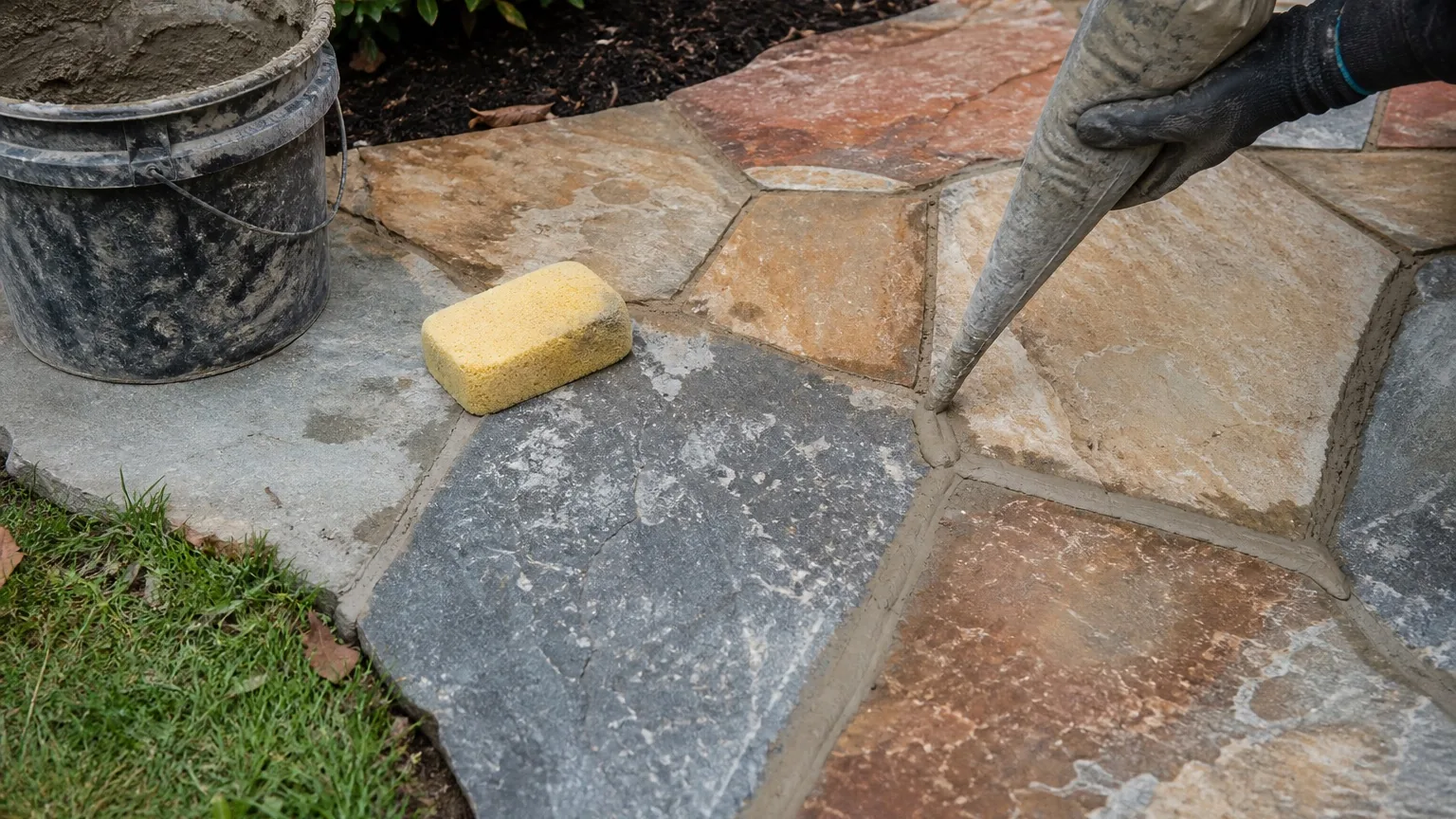
Natural stone. Flagstone, fieldstone and cut stone for patios, steps, wall caps and veneers. A flagstone patio is a good example of how a material choice changes the whole method. We use flagstone around 1 to 2 inches thick, and our preferred way to lay it is what the trade calls the wet method: the stones are set in a wet concrete mix, which gives them a solid, permanent bed, and then the joints are filled from a piping bag so the mortar lines finish clean. No two flagstone patios come out alike, which is the point of choosing it.
Block. Modular segmental retaining wall block, the workhorse for walls on a sloped lot. A gravity wall relies on its mass and a wide base. When the height, the slope or the load above calls for more, we build reinforced segmental walls with Geo-Grid for the proper load bearing.
Concrete. Poured or finished in place: stamped concrete and overlays, exposed aggregate, brush finish, resurfacing, and the footings that masonry sits on. Concrete is also what sits underneath wet-set flagstone and mortared brick, which is why the line between a paver job and a concrete job is not always where homeowners expect it.
(04)
Why red clay decides the base
What you see in a finished hardscape project is not what makes it last. The surface is the top few inches. What matters is what sits under it, and on the Piedmont that means clay.
The USDA's official description of the Cecil series (revised November 2025), a very deep Piedmont upland soil found in North Carolina, South Carolina, Georgia, Virginia and Alabama, shows how quickly that clay arrives. In its typical profile the top 8 inches are sandy loam, and from 8 to 26 inches down the soil is red clay that the USDA Natural Resources Conservation Service describes as firm, sticky and plastic. Dig a patio out on a lot like that and you are standing on clay before you have gone the depth of a spade.
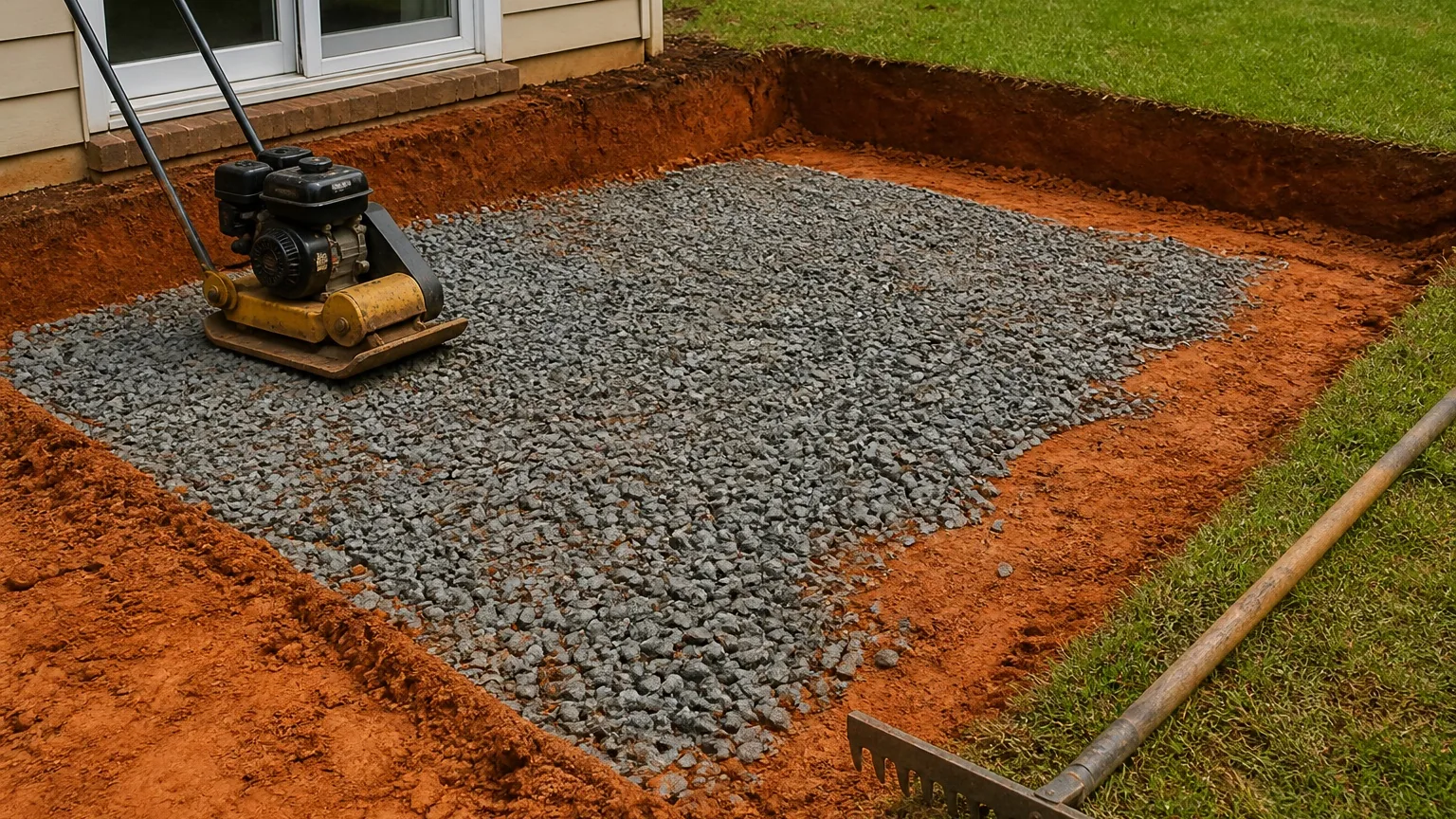
That is why our own build standard reads the way it does. We over-spec the compacted base and set walls and patios on ground prepared to hold their line through the seasons, and grading, drainage and downspout routing are designed in before the first paver is set. On a lakefront lot, that sequence is the difference between a wall that holds and one that leans. Our guide to building hardscape on the shoreline goes further into slope, access and the shoreline rules that apply at the water's edge.
For a homeowner, the practical takeaway is short. When two quotes for the same patio differ, compare what each one says is going under the surface before you compare the surface itself.
(05)
Hard surfaces change where the rain goes
A lawn lets rain soak in at whatever rate the soil beneath allows. A solid patio, a concrete walk or a mortared terrace sends it sideways. The North Carolina Department of Agriculture and Consumer Services puts the mechanism in one line in its permeable pavement manual: traditional asphalt and concrete pavements are impermeable and convert nearly all rainfall to runoff. That is not a reason to avoid hardscape. It is a reason to decide, before anything is built, where the water off a new patio is going to go.
On a lake lot that question has a direction built into it. The ground falls toward the water, and whatever a new terrace sheds lands on the slope below it, on the wall that holds that slope, or against the house if the patio was pitched the wrong way. That is why grading and downspout routing sit in the same design as the patio rather than in a separate job afterward, and why the three-tier retaining wall on our Mooresville lakefront job has drainage behind every course.
The size of the hard surface matters too. A narrow walk sheds little. A large terrace joined to a driveway and a roof downspout can put a lot of water in one place during a summer storm, and the Piedmont's native soils limit how fast it soaks in. Plan the outlet at the same time as the surface, not after the first storm shows you where it went.
The obvious answer would seem to be permeable pavers, which let water through the joints into a stone reservoir underneath. On Piedmont clay that answer comes with conditions. The manual states that the department's Community Conservation Assistance Program funds permeable pavement projects only in the Coastal Plain, Sandhills and barrier islands, because storm water infiltration is limited by the native soils, and its manual sets a screening bar of more than 0.5 inches per hour of infiltration through the top 3 feet of soil.
"Permeable pavements function best when sited on sandy soils, such as those found on barrier islands, the Coastal Plain, and the Sandhills."
— NCDA&CS Community Conservation Assistance Program, Permeable Pavement manual, section 10
That does not rule permeable pavers out around the lake. The same manual notes that state runoff-reduction credit for permeable pavement can be given case by case in the Piedmont, and it says permeable pavement should never be installed without field-testing the soil's infiltration rate. Slope is the second condition. The state's own design manual for permeable pavement, NCDEQ Stormwater Design Manual chapter C-5 (revised November 20, 2020), sets a 2 percent maximum slope for the soil subgrade under permeable pavement built to state stormwater standards, and in silty or clayey soils it calls for clean coarse sand over the ripped subgrade. On a lot that falls toward the water, meeting that takes grading work before any paver goes down. So on red clay, grading, surface drainage and a planned outlet for the water do more of the work than the pavers do. If water is already pooling in the yard, our piece on fixing standing water in a Carolina yard walks through finding the cause before choosing a fix.
(06)
Hardscaping and landscaping are two trades
People search "hardscaping vs landscaping" as if they were rival products. They are closer to two trades working on the same house, the way a framer and a painter both work on a room.
A hardscape company moves soil, sets grade, installs drainage, builds the base and then builds on it: patios, walls, steps, kitchens, fire features, masonry. The work is heavy, machine-driven and permanent, so the risk sits underground.
A landscaper plants, mulches, seeds, installs irrigation and maintains what grows. The equipment is lighter, the work is seasonal, and a lot of it is ongoing: mowing, pruning, replacing what did not take.
The two overlap at the edges, which is where confusion starts. Some landscapers lay a small paver walk; some hardscape firms do light planting. For our part, the line is clear. We grade and prepare the ground and leave planting beds ready, and we are happy to coordinate with your landscaper or recommend one, but we do not plant, mow or maintain lawns.
The order matters more than who does what. Hardscape goes first, because excavation, machine access and base work would flatten anything planted in the way. Our three-tier lakefront wall in Mooresville shows the sequence: excavation and the first courses over compacted base, then three engineered tiers with drainage behind every course and the beds freshly mulched, then a season later the planted terraces filled in and a level lawn where there had been a failing bank. Stone first, plants second, time third.
On cost, the two are priced on different things. A hardscape quote is driven by what is under the ground, how machines reach it and what is attached to the flat part: a seat wall, steps, a fire pit, a kitchen. That is why a hardscape price only means something after someone has walked the site.
(07)
What a hardscape company does, start to finish
If you are talking to a hardscape company in Lake Norman for the first time, it helps to know what the process should look like. Ours runs in four stages.
- Consultation and site review. We walk the property with you and look at grade, drainage, access and what you want the space to become. Access is not a small item on a lake lot, where a steep side yard can decide how material gets to the back.
- Design and proposal. Schematic drawings, material specifications and a written proposal. The estimate is free and carries no obligation.
- Build. A pre-construction meeting, then one crew with an on-site manager, scheduled and communicated. One crew runs from excavation to the final walkthrough, with no handoffs.
- Walkthrough. A full walkthrough and cleanup at the end. The project is done when you say it is.
The point of one company holding the design, the build and the warranty is accountability. When the patio, the wall under it and the drain behind the wall are built by the same crew, there is nobody else to point at if something moves.
(08)
When hardscape is not the answer
It is worth saying plainly: not every yard problem needs stone.
- If the goal is shade and green, a planting plan from a landscaper may deliver more than a new patio would.
- If the budget is tight, a smaller patio on a proper base beats a large one on a thin base. The surface can grow later; a failed base has to come out.
- If you want to change the yard every few years, hardscape is the wrong medium. It is built to stay.
- If water is the real complaint, fix the water first. A patio laid over an unsolved drainage problem inherits it.
And one practical limit: if the job you have in mind is mostly plants, beds and lawn with a little edging, call a landscaper. We would rather send you to the right trade than build you something you did not need.
(09) Questions
Frequently asked questions
What is hardscaping?
Hardscaping is the built, non-living part of a yard: patios, walkways, driveways, retaining and seat walls, steps, outdoor kitchens, fireplaces and fire pits, plus the grading and drainage that sit underneath them. It is built from pavers, natural stone, block, brick and concrete.
What is the difference between hardscaping and landscaping?
Hardscaping is the built part of a yard and landscaping, in the narrow sense called softscape, is the living part: lawn, shrubs, trees and planting beds. They are built by different trades, and the hardscape goes in first because excavation and machine access would damage anything already planted.
What materials are used in hardscaping?
The main families are pavers (brick, concrete and porcelain), natural stone such as flagstone and travertine, segmental retaining wall block, and poured or finished concrete. Stone veneer and outdoor marble tile are used as well. The base underneath is compacted crushed stone or a concrete bed, depending on the method.
Does a new patio increase runoff?
A solid patio does. North Carolina's agriculture department notes in its permeable pavement manual that traditional asphalt and concrete pavements are impermeable and convert nearly all rainfall to runoff, so the grading and the outlet for that water should be designed with the patio, not after it.
Are permeable pavers a good idea on Lake Norman clay?
They can work, but with conditions. North Carolina's agriculture department notes in its permeable pavement manual that its Community Conservation Assistance Program funds permeable pavement only in the Coastal Plain, Sandhills and barrier islands because infiltration is limited by the native soils, and it calls for field-testing the soil first. On Piedmont red clay, grading and a planned outlet for the water carry more of the load.
Should hardscaping or landscaping go in first?
Hardscaping goes first. Excavation, base work and machine access would flatten plants already in the ground, so the patio, walls, steps and drainage are built first and the beds are left graded and ready for planting afterward.
Does Carolina Custom Stone and Hardscape do landscaping?
No. Carolina Custom Stone and Hardscape is a hardscape contractor building patios, walls, walkways, driveways, kitchens, fire features, masonry, drainage and paver sealing. The crew grades and prepares the ground and leaves planting beds ready, and will coordinate with your landscaper or recommend one, but does not plant, mow or maintain lawns.